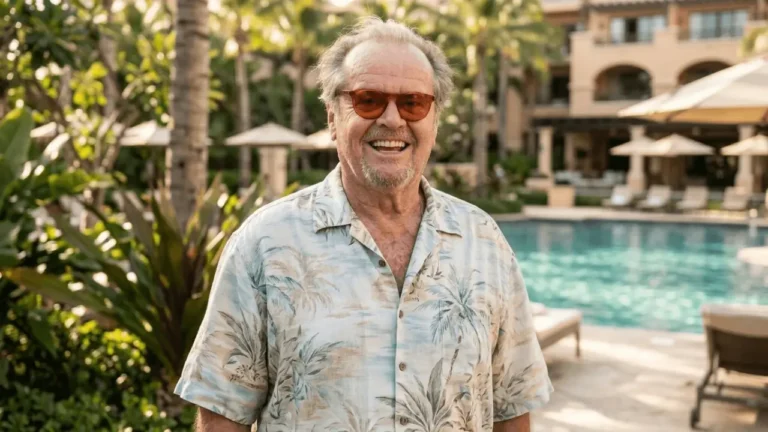
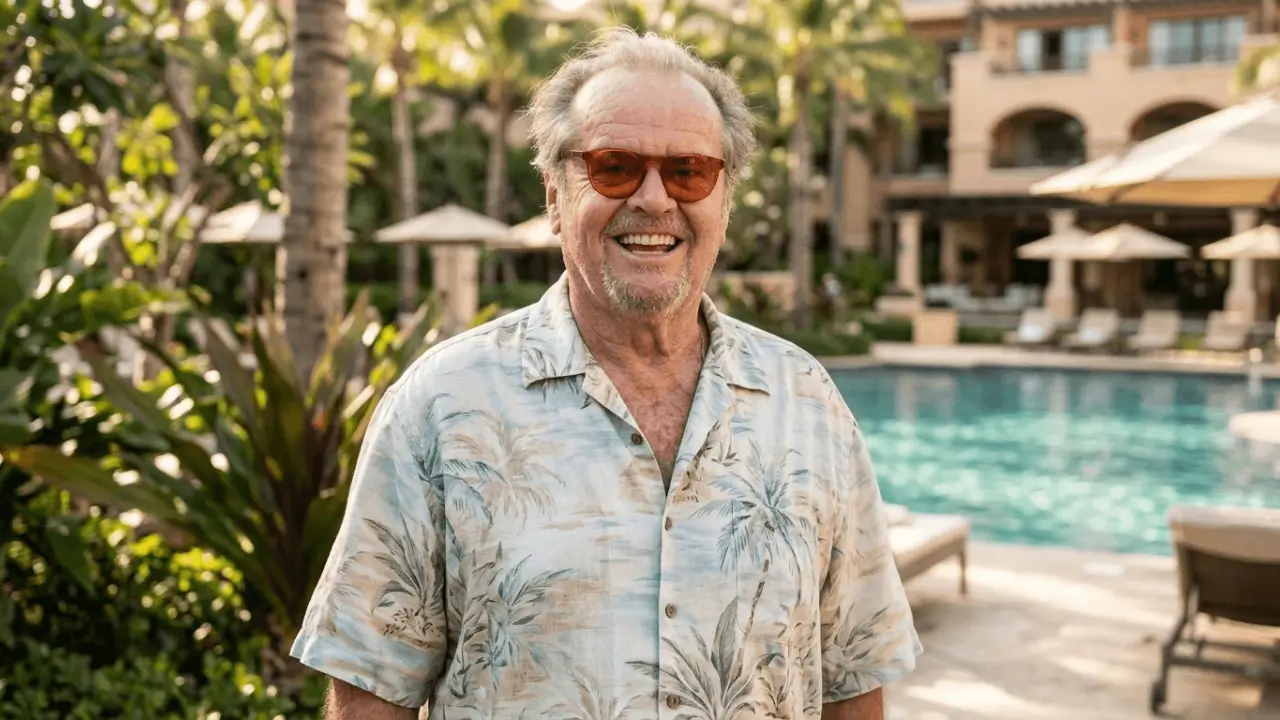
Jack Nicholson Net Worth in 2026 is estimated at roughly $400 million, a figure that reflects far more than decades of memorable performances. It is the financial result of a rare Hollywood career built on risk, leverage, real estate, art, and an instinct for ownership that most actors of his generation never developed.
At 89, Nicholson has not appeared in a feature film since 2010’s How Do You Know. Yet his wealth has continued to command attention because it is unusually durable. Unlike many celebrities whose fortunes fade when the paychecks stop, Nicholson’s money was designed to outlast the spotlight. His estimated $400 million net worth rests on a combination of film salaries, profit participation, a major art collection, and one of the most valuable private real-estate portfolios in Los Angeles.
The renewed interest in Jack Nicholson Net Worth in 2026 is not merely celebrity curiosity. It offers a case study in how an artist can convert cultural influence into long-term financial independence.
Why Jack Nicholson Net Worth in 2026 Matters
Jack Nicholson Net Worth in 2026 matters because it represents a model of wealth creation that has become increasingly rare in modern Hollywood. Today, many actors earn enormous upfront salaries but have limited ownership of the projects that make them famous. Nicholson, by contrast, understood early that a movie’s real money often arrives after opening weekend.
His landmark Batman deal in 1989 changed that equation. Rather than pursuing only a larger base salary to play the Joker, Nicholson negotiated a share of the film’s box-office and merchandising revenue. The arrangement reportedly generated more than $60 million for him, an extraordinary sum at the time and one that remains one of the most influential backend deals in film history.
That deal matters beyond Nicholson personally. It demonstrated that a star’s likeness, performance, and cultural association with a character could be worth more than the acting fee itself. In an era when franchises now dominate global entertainment, Nicholson’s Batman agreement looks less like a negotiation and more like a preview of the modern intellectual-property economy.
Jack Nicholson Net Worth in 2026 also matters because it shows how wealth can be preserved without constant work. Nicholson has spent much of the past decade and a half away from film sets, but his assets have continued to appreciate. His art collection, property holdings, and legacy licensing value have allowed his fortune to remain relevant even as his public appearances have become rare.
The Architecture of a $400 Million Fortune
The headline number is simple: approximately $400 million. The structure behind it is more interesting.
Nicholson’s wealth did not come from one lucky role. It came from a long sequence of decisions: accepting lower upfront pay when ownership was available, buying property before Los Angeles became prohibitively expensive, collecting art before the market exploded, and maintaining enough independence to negotiate from strength.
His career includes more than 60 films, 12 Academy Award nominations, and three Oscar wins. Those achievements gave him leverage, but leverage alone does not create a $400 million fortune. Nicholson repeatedly used his leverage to secure participation in the upside of his work.
| Asset Category | Estimated Value | Share of Estimated Net Worth | Why It Matters |
|---|---|---|---|
| Film salaries and backend participation | $100 million | 25% | Includes decades of acting fees, bonuses, and profit-sharing deals, especially from Batman |
| Art collection | $200 million | 50% | A major private collection featuring works associated with Picasso, Matisse, Monet, Modigliani, Magritte, Rodin, and others |
| Real estate portfolio | $100 million | 25% | Includes a Mulholland Drive compound and properties in Malibu, Hawaii, Aspen, Santa Monica, Venice, and Northern California |
| Total estimated net worth | $400 million | 100% | Based on widely cited 2026 estimates |
This table explains why Jack Nicholson Net Worth in 2026 cannot be understood as a bank balance. Much of his wealth is illiquid, tied up in property and museum-quality art. That makes the estimate less precise than a corporate valuation, but it also makes it more resilient. Real estate and blue-chip art are not easily replicated assets, and both have historically appreciated over long periods.
The Batman Deal That Changed Everything

No discussion of Jack Nicholson Net Worth in 2026 is complete without Batman.
In 1989, Tim Burton’s Batman turned the Joker into one of cinema’s most profitable villains. Nicholson reportedly accepted a lower upfront salary in exchange for a percentage of the film’s gross receipts and merchandise revenue. The decision proved extraordinary. The movie became a global phenomenon, and Joker merchandise became a cultural industry of its own.
The deal reportedly earned Nicholson between $60 million and $90 million depending on how the participation was calculated. Even at the lower figure, it was a transformative payday. It also established a principle: an actor’s contribution to a franchise’s identity can be worth a share of its commercial life.
Nicholson’s Joker was not simply a performance. It became part of the character’s modern mythology. Decades later, the Joker remains one of the most valuable figures in entertainment, appearing in films, television, games, comics, merchandise, and theme-park experiences. Nicholson’s early recognition of that value places him among the most financially astute actors of his era.
This is why Jack Nicholson Net Worth in 2026 is not just a number attached to an aging star. It is evidence of a financial philosophy: own a piece of the thing people will remember.
Art: The Largest and Least Understood Asset
The most surprising component of Nicholson’s fortune is his art collection. Estimated at around $200 million, it represents about half of Jack Nicholson Net Worth in 2026.
Nicholson began collecting in the 1960s, when he was still establishing himself as an actor. Over time, he assembled a collection associated with some of the most important names in modern and contemporary art, including Pablo Picasso, Henri Matisse, Claude Monet, Edgar Degas, Amedeo Modigliani, René Magritte, Fernando Botero, and Auguste Rodin.
The collection’s value is not accidental. Nicholson bought with the eye of a passionate collector, but he also benefited from timing. Much of the art market’s dramatic appreciation occurred after he had already acquired significant works. What may have begun as personal enthusiasm became one of the most valuable private collections in Hollywood.
There is also a psychological dimension. Nicholson has long been associated with independence, contradiction, and an unwillingness to be easily categorized. His art collection reflects that sensibility. It is not a portfolio assembled purely for resale; it is a collection built around taste, history, and personal fascination.
Still, from a financial perspective, the art is a powerful asset. It diversifies his wealth away from entertainment income, provides potential collateral value, and gives his estate a major store of cultural and monetary capital. If portions of the collection were ever sold, donated, or placed into a foundation, the financial and cultural consequences could be substantial.
Real Estate: The Mulholland Empire
Nicholson’s real estate is the second major pillar of his wealth. His property holdings are commonly valued at more than $100 million.
The centerpiece is his compound in the Beverly Hills area along Mulholland Drive. Nicholson began acquiring property there decades ago, gradually assembling a multi-home estate with gardens, pools, and sweeping views of Los Angeles. What began as a relatively modest purchase evolved into a private compound that now carries immense land value.
His broader portfolio has included homes and land in Santa Monica, Venice, Malibu, Northern California, Hawaii, and Aspen. These are not merely luxury residences. They represent a long-term strategy of buying desirable locations before their full value was apparent.
One of the clearest examples is the Aspen property he co-owned with producer Lou Adler. The pair reportedly bought it in 1980 for about $550,000 and sold it in 2013 for $11 million. The property later changed hands again for a price approaching $60 million. That sequence illustrates how patient ownership in prestigious locations can multiply wealth across generations.
Real estate gives Jack Nicholson Net Worth in 2026 a foundation that does not depend on new film income. It also reflects a distinctly Los Angeles form of wealth: land, privacy, views, and proximity to the industry that made him famous.
A Career Built on Leverage
Nicholson’s financial success cannot be separated from his artistic reputation. He was never merely a bankable leading man. He was an actor whose presence could define a film.
From One Flew Over the Cuckoo’s Nest to Chinatown, from The Shining to Terms of Endearment, from A Few Good Men to The Departed, Nicholson built a résumé filled with roles that became reference points in popular culture. That consistency gave him unusual negotiating power.
By the 1990s and early 2000s, he was regularly commanding eight-figure salaries. He reportedly earned $15 million for As Good as It Gets, $10 million for About Schmidt, and $20 million for Anger Management. Even late in his career, he received about $10 million each for The Departed and The Bucket List.
But the salaries alone do not explain Jack Nicholson Net Worth in 2026. The deeper story is his willingness to trade guaranteed cash for participation in upside. That approach required confidence in his own judgment and in the lasting value of his work.
The Cost and Complexity of Celebrity Wealth
A $400 million fortune also carries complications. High-value art requires insurance, conservation, secure storage, and careful estate planning. A sprawling real-estate portfolio requires maintenance, taxes, staff, and legal oversight. Profit participation can involve audits, accounting disputes, and long-tail revenue questions.
Nicholson’s wealth is therefore not simply passive. It is an ecosystem that needs management. At his age, succession planning becomes especially important. The eventual handling of his art collection, properties, and intellectual-property interests could shape both his financial legacy and his public legacy.
There is also the question of philanthropy. Nicholson has previously been linked to a major land donation in Los Angeles, with reports describing a 60-acre gift that helped preserve open space in the Coldwater Canyon area. If true, it suggests that his relationship with wealth has not been exclusively accumulative. It also hints at how his estate may eventually balance private family interests with public cultural or environmental giving.
Will Nicholson Work Again?
The biggest question surrounding Jack Nicholson Net Worth in 2026 is not whether he needs money. He clearly does not. The question is whether he wants one final role.
Recent reports have suggested that Nicholson may be more open to a cinematic return than previously believed. He has not formally announced retirement, and those close to him have reportedly encouraged the idea of one last performance. A rare appearance at SNL50: The Anniversary Special renewed public interest in his whereabouts and reignited speculation about a comeback.
Financially, a return would not materially change his net worth. At his level of wealth, another $10 million or $20 million salary would be meaningful but not transformative. Culturally, however, it would be enormous. A final Nicholson performance would become an event, likely driving streaming traffic, retrospective coverage, merchandise interest, and renewed attention to his entire catalog.
That is the unusual power of his position: even inactivity has commercial value. His past work continues to circulate through streaming platforms, restorations, auctions, and anniversary coverage. The Shining, A Few Good Men, and The Departed remain fixtures in popular culture, ensuring that his name continues to generate attention without requiring new labor from him.
The Future of the Fortune
Looking ahead, Jack Nicholson Net Worth in 2026 could move in several directions.
If the art market remains strong, his collection could appreciate further. If Los Angeles luxury real estate stays resilient, his property holdings may continue to grow. If he chooses to sell or donate parts of his art collection, the public may finally gain a clearer view of the scale of his holdings. And if he accepts one final film role, his cultural value could rise again, potentially increasing the long-term worth of his name and image.
The most likely scenario, however, is continuity. Nicholson appears to have built a fortune intended to preserve autonomy, not to chase further growth. His wealth allows him to live privately, support the people and causes he values, and leave behind an estate that reflects both artistic taste and financial intelligence.
The Real Meaning of the Number
Jack Nicholson Net Worth in 2026 is estimated at $400 million, but the number understates what the fortune represents. It is the financial record of a performer who understood that fame is temporary, but ownership can endure.
Nicholson did not simply earn money from movies. He positioned himself to benefit from the afterlife of movies: sequels, merchandise, streaming, restoration, nostalgia, and cultural memory. He bought land when it was attainable. He collected art when it was still personal rather than purely financial. He negotiated as though his image had long-term value, because it did.
That is the real lesson of his fortune. In an industry obsessed with the next payday, Nicholson built something more durable: a portfolio of assets, relationships, and cultural capital that continues to work long after the cameras stopped rolling.
About the Author